The Traditional Roman Catholic Church
Mission Church
Of
The
Philippines
The Immaculate Conception
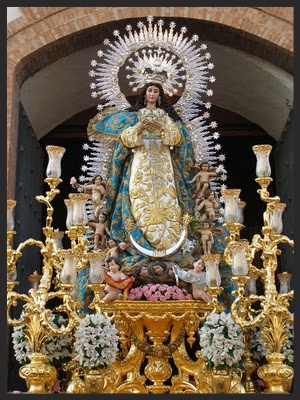
The Immaculate Conception , whose feast falls on December 8, remains the principal Patroness of the Philippine Islands. After the suppression of several Church holydays in the Catholic Calendar of the Philippines, still her feast stays as one of the three holydays of obligation during the year, the other two being Christmas and January 1, when the Solemnity of Mary, Mother of God, is celebrated.
The History of the
Immaculate Conception
In The Philippians
The Stainless Mirror
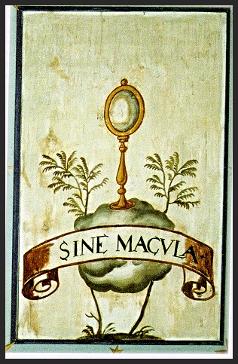
A spheric mirror stands on a hovering cloud. The mirror is an old and well known Marian symbol. Here it signifies Mary's sinlessness. This motif has its origin in the Book of Wisdom (7:26): "She is (wisdom) a reflection of the eternal light, and a stainless mirror of God's majesty." (speculum sine macula) The cloud points to Mary's exalted station, and the two decorative trees flanking the mirror are expressions of youth and purity, reaching beyond this life into eternity.
This symbol of the Immaculate can be found in Raphael Sadeler's engravings of the Litanies of Loreto (1601/04) and Picinelli's Mondo simbolico. The latter refers to the Song of Songs: "Pulchra es ... macula non est in te." [You are beautiful and there is no stain in you." (4:7)]
Giovanni Pierluigi da Palestrina _ Ave Maria a 8(1).mp3
